
The DPDP Adoption Race Is Officially Underway
On November 14, 2025, a long 2-year wait ended with the notification of the DPDP Rules, 2025, a framework that marks the full operationalisation of the DPDP Act introduced in Indian legislature back in 2023. Through a total of 6,915 inputs received from participants across startups, MSMEs, industry bodies, civil society groups and government departments, the DPDP Rules form a clear, citizen-centred framework for the responsible use of digital personal data – placing equal weight on individual rights and lawful data processing.
With deadlines and requirements officially in place, the DPDP Rules officially set in motion an 18-month implementation timeline that many enterprises now have to consider as part of their organizational processes.
To What Extent Do The DPDP Rules Apply To Your B2B Organization?
As a B2B enterprise, you may be under the misconception that the citizen-centric DPDP Rules apply mostly to consumer-facing firms.
That is incorrect – in fact, DPDP applies to any organization (B2B or B2C) that processes digital personal data.
As per the same government bodies that envisioned DPDP, personal data is defined as any information about an individual who is identifiable by or in relation to this information, and digital personal data refers to any personal data which is collected in digital form, or is collected in non-digital form and subsequently digitized.
As such, there is a high likelihood of your enterprise coming under DPDP’s purview. Here’s a quick diagnostic to understand whether (and how deeply) your organization falls under DPDP Rules:
Diagnostic 1: Does your organization deal with employee data?
This includes HR records, payrolls, employee IDs, onboarding documents and access logs. If your enterprise (like 99.99% of enterprises out there) deals with all these things, you immediately fall under DPDP. Every organization that processes employee personal data is termed a ‘data fiduciary’ under the DPDP Rules by default.
Diagnostic 2: Do you process personal data on behalf of your clients?
If you offer B2B services involving IT/ITeS, SaaS, cloud processing, analytics, customer support or managed services, that makes your enterprise not just a data fiduciary, but also a ‘data processor’. As such, not only do you have to be individually DPDP-ready, you also have to support your clients’ DPDP compliance. In this 18-month window, their compliance deadlines become your operational deadlines.
Diagnostic 3: Do you handle workforce data at scale or operate in a critical, highly-regulated sector?
Examples for these sectors include BFSI, healthcare, telecom, manufacturing and public sector contracting. If you (or your clients) operate in them, there’s a good chance you may be designated as a ‘Significant Data Fiduciary’ – a classification that brings far more stringent obligations, including:
- Independent annual audits
- Regular Data Protection Impact Assessments (DPIA)
- Heightened oversight of data flows and cross-border transfers
The Many DPDP Requirements Your Enterprise Has To Be Ready For
The core of DPDP focuses on the data rights of all individuals deemed as a ‘data principal’ in the guidelines. For a B2B organization, these rights will apply to your employees, client representatives, vendor staff, contractors – essentially, anyone whose data you hold. Therefore, you have to create workflows that seamlessly let users exercise all these rights:
- Right To Give Or Refuse Consent: Individuals must be able to freely give or deny consent at the outset before any personal data is processed.
- Right To Know How Data Is Used: They have the right to be informed by your organization about what data is collected, why it’s processed and with whom it’s shared.
- Right To Access Personal Data: They can request a copy of all personal data your organization holds about them.
- Right To Correct Or Update: They can ask for inaccurate, outdated or incomplete personal data to be corrected without any friction.
- Right To Erase: They can request deletion of their personal data, unless it has to be retained for lawful purposes. (More on that later.)
- Right To Nominate: They can appoint someone to manage their personal data in case of incapacity or death.
- Securing of personal data through encryption, obfuscation, masking or use of virtual tokens mapped to that personal data
- Appropriate access control measures for all the resources and devices in your organization
- Visibility on users accessing this personal data, through monitoring of logs that must be retained for a minimum of 1 year
- Business continuity measures for continued processing in the case of breaches or incidents, through secure back-ups
- Enabling safeguarding against unauthorised access through strong detection, investigation and remediation processes
- Any other appropriate technical and organizational measures to ensure effective observance of these safeguards (employee awareness, etc.)
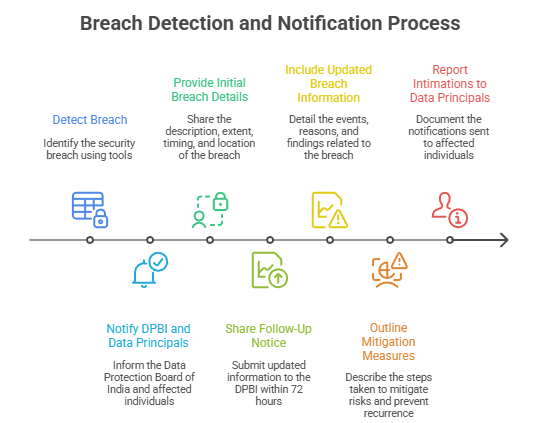
What The Road Ahead Looks Like For Your Enterprise
The requirements are set, and the clock is ticking. DPDP integration should be a core part of your organizational goals moving forward in the near future, because penalties for non-compliance are severe:
- ₹250cr for a breach originating from a failure to maintain reasonable security safeguards
- ₹200cr for not notifying the DPBI or affected principals of a data breach, or violating the obligations related to children’s data rights
- ₹50cr for any other violations of the Act or Rules
In this 18-month timeline, it is highly likely that you may see short-term investment spikes when it comes to DPDP implementation. However, if you zoom out and take the long-term view, you will find that DPDP readiness (as early as possible) has a variety of benefits for your organization:
- Competitive Advantage Through Stronger Client Trust: Being DPDP-ready signals maturity and reliability, helping you win enterprise deals where data governance is a differentiator.
- Stronger Security Posture Across Your Entire Data Lifecycle: DPDP readiness drives security measures (encryption, access control, etc.) that protect all your enterprise data – not just personal data.
- Greater Business Continuity: Mandatory backups, monitoring and response playbooks reduce the chances of downtime, not just breaches.
- Better Vendor & Third-Party Risk Management: DPDP creates a unified standard, elevating the entire supply chain ecosystem and reducing inherited risk from weak partners.
- Compliance Readiness for Other Global Standards: DPDP-aligned practices overlap heavily with prevailing international standards like GDPR, ISO 201, SOC2 and HIPAA, making international expansion and audits far easier.